
What can I use semi-green/semi-dry willow for?
15 January 2026
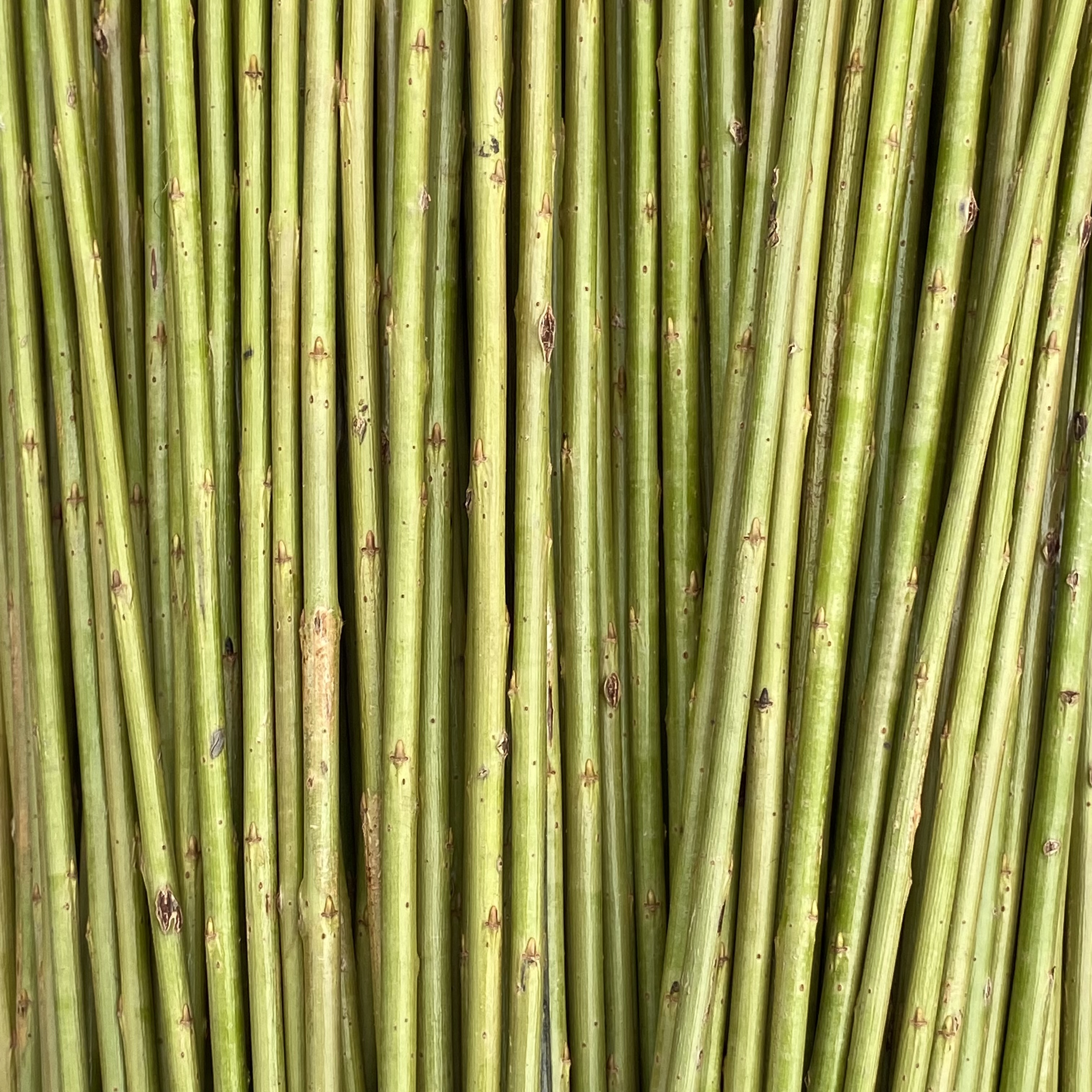
Semi-green or semi-dry willow is willow which is between green and dry. It is partway through the drying process and must be fully and correctly dried before storage, or mould will develop. All our semi-dry willow will eventually be sold as brown (dried) willow.
Semi-green and semi-brown willow refer to the same state of the willow.
It may still be flexible enough for hoops, hurdles, or creating gentle curves, but it is not suitable for basketry weaving, as it continues to lose moisture and will shrink further.

As it dries, the colour changes and develops; the rods become blotchy as they transition to their final dried colour. Some may appear marked black (Dickie Meadows in particular-see above photo), but this is COMPLETLY NORMAL.
There is usually a pause in sales in late spring/early summer to allow the drying process to take place and avoid the need to dry willow at home before storage. It also reduces the risk of mould developing on stored willow that has not been thoroughly dried first.
Importantly:
- as it dries, the flexibility changes
- whilst the outside of the rod may appear dry, the inside may still be drying
- as it dries, it shrinks
- as it dries it may appear wrinkled on the surface (rizzled)
Semi-green/semi-dry willow is not the same as living willow, and it will not strike if planted; however, it may still show signs of sprotuing and living in the early stages- these can simply be rubbed off.
You can only use it when:
- the willow is well into the drying stage and is starting to change colour and become firmer
- shrinkage doesn’t matter in the item being made
- shrinkage can be compensated for later
- the weave is gentle, or you require a hoop or curve, and no sharp corners or turns are needed
You can’t use it for:
- formal basketry weaving, where you need the weave to be tight
- weaves which require turns or tight spaces (zig-zag French, for example)
- bordering, where you need the willow to kink, not crack, or split.
- bases which need to be strong and tight
What can I make with it?
Garden panels or garden edging
You can make willow garden panels or garden edging, and compensate for any shrinkage by compressing the weave as it shrinks to firm it up.
Ensure that any uprights for this type of work (usually sticks) are dry or nearly dry, as the panel will be loose.
Any uprights driven into, or in contact with, the ground need to be put in upside down, or de-barked a few inches from the surface of the ground, to ensure they do not strike.
Seasonal or celebratory wreaths
Shrinkage in wreaths often doesn’t matter because they are usually bound with other materials or are short-lived. Winter-cut willow is often used at the start of the season for such projects.
Circles for sculpture frameworks
Sculptures usually require circles/ovals to form the initial framework, which is then woven over. Semi-dry willow is perfect for this, and several pieces can be made in a range of sizes and shapes (ovals and circles) that you can then assemble into your sculpture framework once they have dried.
Hoops for frame baskets/ribs/handles
Most basketmakers use the flexibility of semi-green willow and spend the late winter/early spring months making hoops, handle liners, and ribs for future projects. As the willow is already in a flexible state, it does not require soaking to prepare it.
Those hoops and ribs are made by hand or on jigs/formers, then left to dry before use in a basket.
Green willow or living willow, will split, shave, trim, and cleave much more easily than re-soaked willow. It can also be shaped with ease using a hooknife, shop knife, or drawknife and a shave horse. Ribs and handles made in this way should always be formed into shape straight away, as they will dry rapidly once they have been de-barked.
Pre-made shapes for other projects:
Jigs can be used in conjuntion with semi-green/semi-dry willow for projects such as swallows, fish, etc. They may be wooden formers, string or similar, which will hold the willow into shape as it dries.
Be aware that green willow may still sprout new growth even after it has been woven. This is just the last of the sap and doesn’t have enough energy to continue growing if planted—simply pick it off.
How to dry the item
If you make anything from green/fresh-cut, living, or semi-dry willow, make sure it has a chance to fully dry out.
Ensure the item you have made is stored with air circulating around it and is not wrapped or covered in any way.
This could be by:
- hanging in a sheltered outside porch for a wreath ring, or hoops/ribs
- drying, more rapidly, inside in a warm but not overly hot place
- leaving it in the garden, in situ, to dry as the seasons warm
Unwrapping willow upon arrival
When you order willow from Musgrove Willows, it should always be unwrapped immediately upon arrival.
While we ship our willow in a bio-based stretch film wrap, you should never store your willow in it or any similar covering that restricts its ability to breathe.
We have a handy video about unwrapping your living willow on arrival – the same tips apply to unwrapping any semi-dry or dry willow.


