
Brown willow soaking times and tips
11 April 2022
Brown willow needs to be soaked prior to use. Depending on the variety, soaking times can be over 1 day per foot of rod length. Forward planning is essential.
How to soak brown willow
Soaking isn’t an exact science. It can be tricky to get right as there are so many variables to take into consideration. The weather, water temperature and the length of time that the willow has been stored will all play a part. That being said, follow these guidelines and you should enjoy soaking success!
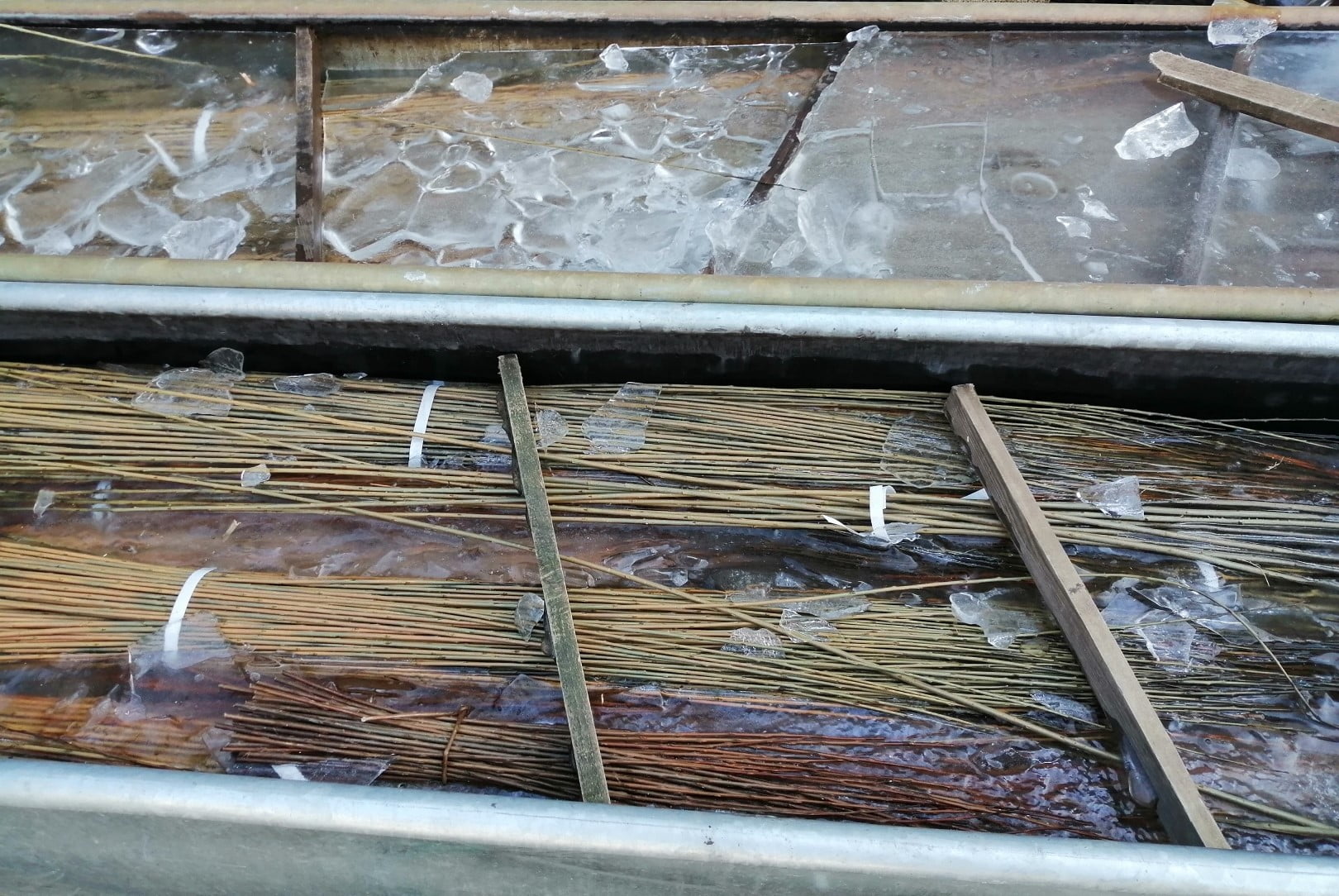
Tips for soaking brown willow
Willow takes longer to soak on a cold winter’s day than on a hot summer one. The times below are a guide to soaking brown willow in clean, cold water on an ‘average’ day. Using warm or hot water will shorten the soaking time. If the willow has been stored for a long period it will take longer to soak.
| Black Maul & Noire de Villaine |
Old French | Dicky Meadows | Flanders Red | Brittany Green | Caledendron | Whissender | Harrisons | |
| 3ft | 3 days | 3 days | 2 days | 4-6 days | 3 days | 5-6 days | 4 days | 3 days** |
| 4ft | 4 days | 4 days | 3 days | 6-8 days | 4 days | 6-7 days | 5 days | 4 days** |
| 5ft | 5 days | 5 days | 4 days | 8-10 days | 5 days | 7-8 days | 6 days | 5 days** |
| 6ft | 6 days | 6 days | 5 days | 10-12 days | 6 days | 8-9 days | 7 days | 6 days** |
| 7ft | 7 days | 7 days | 6 days | 12-14 days | 7 days | 9-10 days | 8 days | 7 days* |
| 8ft | 8 days | 8 days | 7 days | 14-16 days | 8 days | 10-11 days | 9 days | 8 days* |
| 9ft | 9 days | 9 days | 8 days | 16-18 days | 9 days | 11-12 days | 10 days | 9 days* |
* To further improve the working quality of the willow some basket makers recommend steaming for at least 1 hour (preferably 75 minutes). Leave the willow in the steamer until cool.
** Take care when soaking and steaming shorter lengths as the rods can become soft and easily break.
Tips for soaking brown (dry) Caliantha willow
Thank you to Joe Hogan for this information. Joe also recommends placing Caliantha willow in a steaming box for over an hour, (you can construct one using a wallpaper stripper) and then leaving it in the insulated box for several hours until the rods are cool. This helps to improve the working quality of the rods and enables them to be used for up to a week.
Steaming also helps to deepen the colour of the rods and aids skin retention when twisting the willow.
Click here for information on how to use our steaming sheet
| Length of rods | Autumn / Winter without steaming* | Autumn Winter with steaming |
| 3ft | 4 days | 3 days |
| 4ft | 5 days | 4 days |
| 5ft | 6 days | 5 days |
| 6ft | 7 days | 6 days |
| 7ft | 8 days | 7 days |
| 8ft | 9 days | 8 days |
| 9ft | 10 days | 9 days |
*If soaking in warm water or in warm weather, reduce the soaking times above by 1 day.
What to soak in?
A soaking bag has the advantage of being easy to empty and the willow can then mellow in the bag. Our heavy duty soaking bags are available in a range of lengths and widths and are supplied with simple instructions.
Alternatively, willow can be soaked in a bath, trough or old paddling pool. Always ensure that the water is clean! The willow will need to be weighed down to keep it submerged, but do not use metal weights as these will mark the willow. Be wary of soaking willow in your finest bathtub. You may end up with tannin stains.
Once soaked, drain the water and leave the willow to mellow overnight in the soaking bag, lying flat. Hessian, a damp blanket or plastic sheet do the job equally well. Mellowing is a really important part of the soaking process as it enables the inner parts of the rod to become fully pliable.
Unwoven rods
When working with willow, do keep it covered to prevent the rods from drying out. Leftover brown willow can be kept covered for up to a week and still used. After this time, the willow will need to be dried thoroughly before being stored.
When working with willow, keep it covered to prevent the rods from drying out. Un-woven, covered, brown willow can be used for up to a week, dependent on variety, weather, and where it has been stored. After this time, the willow will need to be dried thoroughly before being stored again. Ideally, soak only what you can realistically work with in a couple of days. Stagger your asking/mellowing of the willow accordingly if working on a longer, larger project.
Things to watch out for
Keep brown willow damp for too long (especially in warm weather) and the willow will turn greasy and/or mouldy and the bark will shred. The rods may also squash if used. At this stage, it may be possible to thoroughly dry the willow out before re-soaking. Any mould will need to be wiped off first.
Repeated re-soaking will cause the willow to lose its colour. If a rod starts to get black spots, it is no longer usable. However, if only a few rods are affected, pull these out to stop the mould spreading. The rest of the rods should still be useable.


